

The L.E.A.D. Coaching Model was intentionally developed to support district and building administrators, instructional coaches, and teacher leaders as they navigate the increasing complexity of leading learning in today’s schools. Rooted in research, evidence-based practice and refined through years of hands-on coaching across diverse K–12 settings, the model offers a clear, human-centered approach to leadership development that prioritizes trust, clarity, and impact.
L.E.A.D. equips leaders at all levels with a shared language and practical framework to guide reflection, decision-making, and action, ensuring that leadership efforts remain aligned to vision while staying responsive to the needs of educators and learners. By focusing on listening with intent, empowering through evidence, aligning actions with purpose, and developing capacity over time, the model supports coherent leadership systems that strengthen relationships, build collective efficacy, and sustain meaningful improvement across schools and districts.
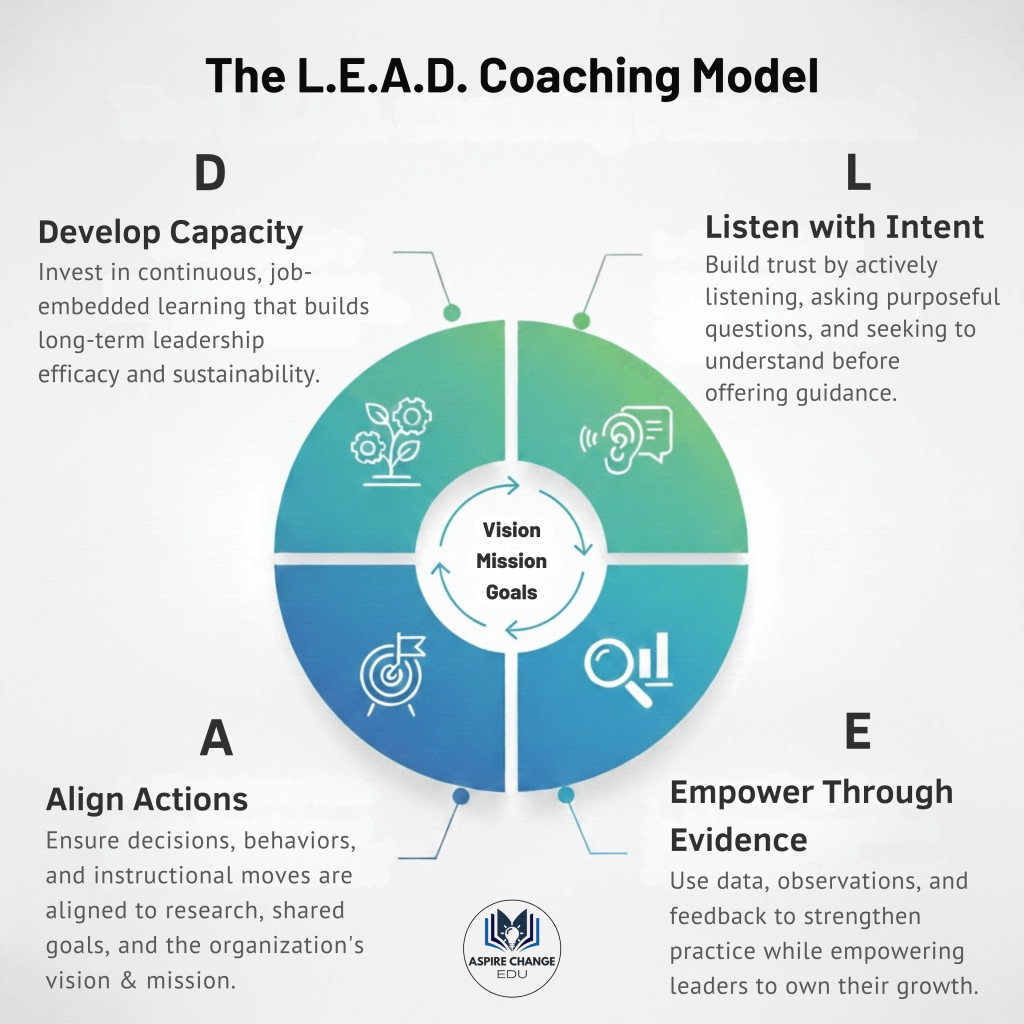
L – Leverage Relationships
Trust and relationships are the foundation for meaningful coaching conversations.
E – Examine Practice
Reflect on instruction, leadership moves, and impact using evidence and observation.
A – Act with Purpose
Translate reflection into intentional, high-impact action steps.
D – Drive Continuous Improvement
Monitor progress, refine strategies, and sustain momentum over time.
The L.E.A.D. leadership coaching model aligns directly with the System for Educational Transformation (SET), the Framework for Pedagogical Leadership, and Aspire Change EDU’s research-based coaching approach, providing a clear, consistent structure that turns vision into sustained practice. Within SET, L.E.A.D. operationalizes longitudinal, evidence-based improvement by grounding leadership growth in intentional listening, empowerment through data, alignment to vision, and continuous capacity-building. This coherence creates clarity for leaders and establishes reliability, both of which are essential for building trust across systems. From a Pedagogical Leadership perspective, including from the lens of artificial intelligence (AI), the model reinforces the belief that leadership is not about managing instruction, but about improving learning by developing strong relationships, analyzing evidence, making time for meaningful feedback, and learning alongside educators.
These actions demonstrate transparency and shared ownership, further strengthening trust between leaders and staff. In practice, L.E.A.D. reflects how Aspire Change EDU coaches leaders by meeting them where they are, listening with intent during learning walks, providing actionable, non-evaluative feedback, aligning next steps with schoolwide goals, and developing capacity through job-embedded coaching and reflection. This consistent, human-centered approach builds credibility, sustains trust over time, and ensures that leadership actions drive measurable improvements in teaching practice and student learning.
Learn more about the Aspire Change coaching process HERE.
Learn more about specific supports related to artificial intelligence (AI) HERE.
